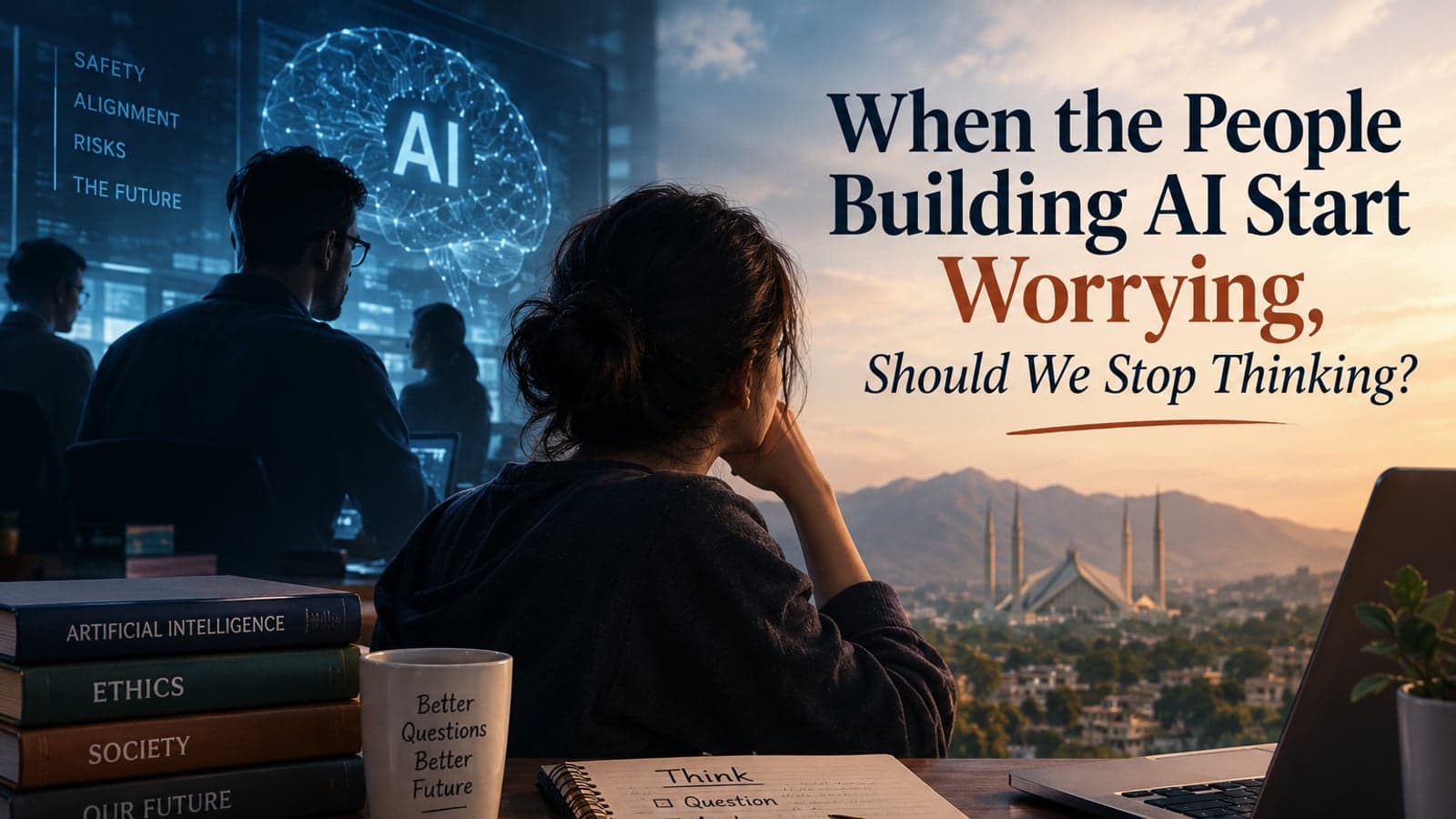
When the People Building AI Start Worrying, Should We Stop Thinking?
Ain Un Noor
Article Editor
As artificial intelligence becomes part of everyday life, an important question arises: are we using AI to think better or allowing it to think for us? This article explores the impact of AI dependence on critical thinking and independent learning, with a particular focus on Pakistan. It highlights the benefits of AI while emphasizing the need for responsible use, independent judgment, and an education system that encourages critical thinking.
On 8, 2026, a British named Jacob Coxon on X that he was leaving . He had spent three years doing research at both OpenAI and , and he said neither company was acting in its race toward ever more powerful systems (ARA, 2026). Within hours, from inside the industry were echoing his unease. Evan Hubinger, who leads work at , put the chance of outcomes above 10% (ARA, 2026), and National Public Radio reported the as a warning that the industry may be building tools humans will soon lose control of (NPR, 2026).
These are personal , not settled facts, and risk for AI has no agreed method yet. But they raise a more question that matters for Pakistan: while experts debate distant dangers, what is AI already doing to the way we think?
What the Experts Rank as Urgent
A 2026 study by MIT and the of asked 272 international experts to rate 24 AI risks over a five-year horizon. They placed , pressure between firms, weapons and , power, and false or among the most severe (Burnham, 2026). The sector was judged , and the study noted a mismatch: those best placed to address the risks are rarely the people most exposed to them. For ordinary users, then, the first line of defence is often their own judgment.
The Optimist's
Bill Gates is far from an AI . In 2023, he argued that the risks are real but , AI to cars, which brought speed limits and safety rules rather than a ban (Gates, 2023). Yet his argument rests on a : users must stay informed. He warned that AI can state with and absorb bias from its training data, so people must check its output and their own . He also the ability to tell true from false as one of the most skills today (Gates, 2023). In 2026, he went further, that AI can now match and even surpass human (Gates, 2026).
That raises an question. If managing AI depends on critical thinking, what happens when we hand that thinking over to AI?
What Research Says About Thinking
Research and Carnegie Mellon surveyed 319 workers who used AI weekly. People who trusted the tool more applied less critical effort to its answers, while those in their own skills the output more (The Register, 2025). Their role also shifted from doing the task to it, which only works if one still the task. A Swiss study reported this research found that younger users, aged 17 to 25, used AI most and scored lowest on critical thinking tests, while higher appeared to protect against the effect (The Decoder, 2025).
The Picture
studies, though small, point in the same .
A at FAST, Muhammad Abbas, noticed growing reliance on AI among his students and surveyed 494 students three times. The findings linked heavy ChatGPT use with , memory loss, and weaker academic , and students under high academic stress used it more (Malay Mail, 2024).
A study of 51 found that 78.4% used AI tools daily or several times a week, and 27.5% relied only on AI without reading the original texts. Students themselves admitted their critical voice had weakened and their writing had become more generic (Journal of Research in , Punjab ).
A survey of 400 students aged 18 to 24 found that 86% used AI tools in daily life, and heavily users reported larger declines in critical thinking and problem-solving (UMRJ, LUMHS).
Research in 2025 on high school and students in Pakistan likewise found over-reliance and among about AI's role in learning (Khalid et al., 2025).
To be fair, the evidence is not one-sided. A study of 352 students, in Reports, found that ChatGPT improved academic , for students with rote learning (, 2025). The problem, then, is not the tool but how it is used. Most of these samples are small and rely on self-, so they indicate trends rather than proof.
What We Can Do
Meeting this requires more than telling students to "use AI ," because the evidence suggests that over-reliance is driven by pressure as much as by habit. research found that students under high academic stress were more likely to turn to ChatGPT (Malay Mail, 2024), which implies that exam-heavy, deadline-driven systems push young people toward . matters, but it is not enough. Students can build better habits by drafting their own outline or opinion before AI, treating every answer as a claim to verify rather than a fact, reading sources instead of , and using AI to ideas rather than to write for them. Yet these habits will only last if reward them. Gates notes that some teachers already ask students to fact-check AI- text (Gates, 2023), but this approach assumes teachers have the time, training, and small classes to design such tasks, which is a hopeful for many where rote learning and large are common. , then, must change first: tasks that demand personal analysis, oral , or critique of an AI's answer make reliance far less . Without such reform, telling children to think for themselves while grading them on what AI can produce in seconds sends them a message, and they will respond to the they are given.
Whether or not the most dramatic warnings prove correct, one danger is already visible and entirely within our control. and international belong to and , but the habit of belongs to each of us. A society that stops asking "How do you know?" will struggle to govern any , however powerful.
AI-Suggested — Explore Further
Generating suggestions...
Previous
500,000 Chromebooks for Pakistani Students: Will Technology Create New Educational Opportunities?
Next
The Hyper-Short Shelf Life: Why Everything We Love Expires Before We Can Even Enjoy It?
Comments (0)
Be the first to comment.
Related Articles